Datatruck Raises $12M Series A to Accelerate AI-Native TMS for Carriers
2/28/26, 1:03 AM
Why Carrier-First TMS Software Outperforms Every Broker-Adapted Platform
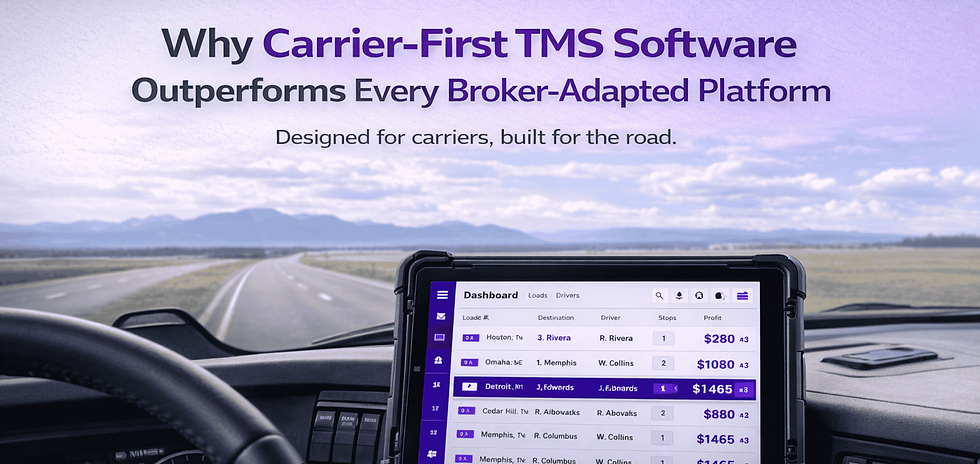
Most TMS software for carriers was not built for carriers. It was built for freight brokers, and at some point the vendor added a carrier module and called it a fit. The architecture tells the truth even when the sales pitch doesn't.
For asset-based carriers running 20 to 500 trucks, the difference between a platform built from the ground up for carrier operations and one adapted from broker tools shows up every single day: in dispatch workflows that don't match how you actually book loads, in financial reports that show revenue but hide profit, and in driver pay processes that require manual reconciliation no one has time for.
What Makes TMS Software Carrier-First vs Broker-Adapted
The distinction goes deeper than a feature list. It's about what the platform was designed to optimize.
A broker-first platform is built to manage shipper relationships, match freight to capacity across a network, and track margin from the brokerage side. When carriers use it, they're working against the grain of the architecture. Carrier-specific workflows get bolted on as modules. Financial visibility defaults to revenue, not profit. Driver settlement is an add-on, not a core workflow.
A carrier TMS is built around the opposite priorities: truck utilization, load profitability, driver pay, compliance, and cost per mile. Every screen, every workflow, and every report is designed for how carriers actually operate, not how a broker thinks carriers should operate.
The easiest way to tell the difference: ask the vendor where profit per load sits in the platform. If the answer involves a report you run at month end or a separate accounting integration, that's a broker-adapted platform. Carrier-first TMS software shows profit per load, per truck, and per lane in real time, as the load moves, not after your accountant reconciles everything.
The Workflows a Carrier TMS Handles That Broker Platforms Cannot
The gaps in broker-adapted platforms become visible fast once a carrier is running day-to-day operations on them.
Workflow | Broker-Adapted TMS | Carrier-First TMS |
Load creation from rate confirmation | Manual data entry, 3-5 minutes per load | TruckGPT creates load in under 15 seconds |
Multi-board load search | Separate tabs, manual comparison | AI Dispatcher searches DAT, TruckStop, RXO, and 100+ boards simultaneously |
Driver settlement | Manual calculation, separate payroll module | Auto-calculated from completed load data, visible in driver app |
Broker communication | Manual calls and emails at each stage | AI Updater sends automated updates 24/7 |
Profit visibility | Month-end report after reconciliation | Real-time per load, per truck, per lane |
Each of these gaps has a daily cost. A dispatcher entering rate confirmations manually at 4 minutes per load across 30 loads a day is spending 2 hours on data entry alone. That's time not spent booking the next load or managing exceptions. The hidden costs of manual dispatching compound quickly at scale.
How Carrier-First Architecture Affects Financial Visibility
This is where broker-adapted TMS platforms fail carriers most consistently, and where the cost is hardest to see until it's already done damage.
When a platform is built for brokerage, financial visibility defaults to gross revenue and load margin from the broker's perspective. That's not what an asset-based carrier needs. A carrier needs to know:
What did this load actually cost after fuel, tolls, lumper fees, and accessorials?
Which of my trucks made money this week and which ran at a loss?
Is the Chicago to Dallas lane worth running at current spot rates?
What is my true cost per mile right now, not last month?
None of those questions get answered by a revenue report. They require cost attribution at the load level, connected to live operational data from ELDs, fuel cards, and factoring. Most carriers never track profit per truck because their TMS makes it genuinely difficult. That's an architecture problem, not a reporting problem.
Datatruck's financial visibility layer is built into the core of the platform. Profit per load updates in real time as costs hit. Per-truck and per-lane profitability is visible without running a single report. Carriers using the BI Agent can ask profitability questions in plain English and get answers backed by live data instantly.
Can a Broker TMS Work for Asset-Based Carriers?
It can work in the sense that loads get created and invoices get sent. But working and performing are different things.
Carriers on broker-adapted platforms consistently work around the platform rather than with it. Spreadsheets fill the gaps the TMS leaves open. Dispatchers develop manual processes for things the system should automate. Financial visibility requires exports and reconciliation. Driver pay runs in a separate system that doesn't talk to dispatch.
The workarounds seem manageable at 20 trucks. At 80 trucks they become a serious operational drag. Ray Cargo was managing 50 trucks across five different tools before switching to Datatruck. After one week on the platform, they eliminated all five spreadsheets and the manual processes that came with them. They now run 350+ trucks on the same system.
Should Carriers with Both Assets and Brokerage Use One TMS or Two?
This is a legitimate question for hybrid operations, and the answer depends on which side of the business is larger and where the operational pain is greater.
For carriers whose primary business is asset-based trucking with some brokerage on the side, a carrier-first TMS with brokerage capabilities handles both without compromise. The carrier workflows are native. Brokerage functions are supported without requiring a separate platform.
For operations where brokerage is the majority of the business and asset operations are secondary, a broker-first platform may be the right core, with carrier modules handling the asset side. But for any carrier where trucks, drivers, and load profitability are the center of the operation, starting with a broker TMS and trying to fit carrier operations into it is building on the wrong foundation.
PAVA Logistics runs 200 trucks with a lean team by relying on real-time cost and profitability data that their previous platform couldn't provide. The switch to a carrier-first TMS changed how they make decisions at every level of the operation.
For carriers that want their accounting to match their operational data automatically, Fintruck provides purpose-built trucking accounting that integrates directly with Datatruck's TMS. Revenue, driver settlements, and operating costs flow from the dispatch board into your financials without manual reconciliation. It's the accounting complement to a platform that was built for carriers from day one.
Datatruck is the TMS for carriers built around one principle: carriers need to know where their money goes, in real time, at the load level. Not adapted from broker tools. Not patched together from modules. Built from the ground up for how asset-based carriers actually operate. See how carriers are running leaner, more profitable operations after switching to a platform that was built for them.
Book a free demo and see what carrier-first TMS software looks like when it's actually built for carriers.
Frequently Asked Questions
What makes a TMS carrier-first vs broker-adapted?
A carrier-first TMS is built from the ground up around carrier operations: truck utilization, load profitability, driver pay, compliance, and cost per mile. A broker-adapted TMS starts from a brokerage architecture and adds carrier features as modules. The difference shows up in financial visibility, driver settlement workflows, and how deeply dispatch connects to operational data.
Why do carrier-specific TMS platforms outperform general logistics software?
General logistics software optimizes for the widest range of use cases. Carrier-specific TMS software optimizes for carrier operations exclusively. Every feature, every report, and every workflow is designed for how asset-based carriers run freight, which means less time spent working around the platform and more time running the business.
What workflows does a carrier-first TMS handle that broker TMS cannot?
Real-time profit per load, per truck, and per lane. Driver settlement connected directly to dispatch data. Automated broker communications at every load stage. Document processing from rate confirmation to load creation in seconds. Cost per mile tracking that updates as operational costs hit, not at month end.
How does carrier-first architecture affect dispatch and financial visibility?
Carrier-first architecture connects dispatch and financial data at the load level. When a load is dispatched, costs are attributed automatically: fuel from fuel card integrations, tolls from toll management integrations, accessorials from the load record. Profit updates in real time. Dispatchers and owners see the same financial picture without waiting for reconciliation.
Can a broker TMS work well for asset-based carriers?
It can process loads and generate invoices, but asset-based carriers consistently develop manual workarounds to fill the gaps broker platforms leave open. Financial visibility requires exports. Driver settlement runs separately. Cost attribution is incomplete. At small fleet sizes this is manageable. At 50+ trucks it becomes a significant operational drag.
What problems arise when carriers use broker-first TMS software?
The most common problems are limited financial visibility, manual reconciliation between dispatch and accounting, driver pay processes that don't connect to load data, and dispatcher workflows that require too many manual steps. Carriers on broker-first platforms often describe their operation as running on the TMS plus several spreadsheets that fill the gaps.
Should carriers with both assets and brokerage use one TMS or two?
For carriers where asset operations are the core business, a carrier-first TMS that supports brokerage functions is the right foundation. Starting with a broker TMS and adding carrier modules means the carrier workflows will always be secondary. The platform should be built around your primary business model, not adapted to it.